Three distinct groups of smart people. One opportunity. Three different languages. The result? Complete confusion.
Key Takeaways
- AI vendors and operators are solving the same problem in two different languages — and the disconnect costs both sides most of the value.
- Understanding how AI capabilities compound when connected is the key to realizing maximum value.
- Vendors are pricing at 10–20% of their potential ACV because they're pricing tasks, not the system those tasks create.
- Operators capture 20–30% of potential AI value because tools deployed in silos fragment rather than compound.
- The translators fluent in all three languages are about to become the most valuable people in B2B AI — the market is already starting to price it.
The Rosetta Stone
By 1799, it had been around 1,350 years since anyone understood hieroglyphics. Scholars puzzled over the symbols but without the key to decrypt the code, they were meaningless. And then, as Napoleon’s French forces invaded Egypt, a soldier noticed a slab of black granite that had been used as a building block in a fort near the town of Rosetta, in the Nile Delta. Carved into it, a single piece of tax propaganda, repeated in hieroglyphics, Demotic, and Greek.
Hieroglyphics and Demotic had been lost to time but Greek was a language that remained widely written and spoken. With that discovery, the other two scripts could be deciphered.
Demotic came first. It looked more like a language than the ornamental hieroglyphics, so its patterns were easier to recognize. In actual fact, it combined visual elements with phonetic links. Once that was understood, Demotic bridged the gap between the long-lost archaic script and the currently-understood modern language. An entire ancient civilization became legible.
Business-to-business AI has a translation problem in the here and now.
Two groups — AI builders and the operators deploying them — are looking at the same opportunity and seeing entirely different things. Each group knows its material. Each is solving a version of the same challenge: how AI transforms go-to-market. And they are consistently, expensively, talking past each other.
Not because anyone is wrong. Because the script that would let them understand each other hasn’t yet been decoded. Builders are right about capabilities. Operators are right about constraints. Coordination economics is right about the system. None of these cancels the others out — and none of them, on its own, is enough.
The Hieroglyphics
This is the language of builders. Precise. Technical. Capability-centric.
Builders can tell you exactly what their agents do. How the research agent crawls data sources. How the model processes unstructured inputs. How the enrichment system maps organizational structures. They measure the world in accuracy rates, processing speed, context windows, and token efficiency.
They are very good at describing what each component does in isolation.
What they struggle with is explaining why it matters when those components work together inside a customer's environment. They can tell you Agent A processes accounts 50x faster than a human. They can't easily articulate why that speed — combined with Agents B, C, and D — fundamentally changes how a company makes revenue decisions.
This isn't a criticism. It's a structural feature of building technology. When you're inside the codebase, you see nodes. The network those nodes create in someone else's business is almost invisible from where you sit.
The result: brilliant products with mediocre positioning. Pricing anchored to task metrics — speed, volume, tokens — instead of the value the system actually creates.
The Greek
This is the language of operators. The people running revenue teams, launching campaigns, closing deals, and managing the distance between strategy and Monday morning.
Operators don't think in architectures. They think in handoffs. The SDR-to-AE transition where deal context evaporates. The campaign data that marketing generates but sales never sees. The customer signal that sits in a call recording and never reaches the product team.
They speak in constraints: budget cycles, hiring freezes, legacy systems, executive politics, the team member who won't adopt the new tool. They know the theoretically correct answer is often practically impossible, and they've learned to find the path between the two.
But operators lack visibility into what AI capabilities make possible. They hear vendor pitches that describe features and struggle to map those features onto their specific problems. "Save 5 hours a week on research" sounds— fine, but does that actually change how my team identifies accounts? "AI-powered personalization" — sure, but how does that plug into the outreach workflow we already have?
They need Capabilities translated into their terms. And when they look across the table at the builder, neither side can find the words.
"We need tools that fit our workflow" quietly becomes "we'll buy one more and hope it coordinates with the others" — which is how organizations end up with twelve AI tools and no coordinated system. Operators have their own version of staying inside the codebase.
The Cracked Stone
The Rosetta Stone worked because it had three scripts, and the middle one — Demotic — bridged the gap between the other two. It was the connective tissue that made hieroglyphics legible to Greek readers and vice versa.
Now imagine the stone with the middle script missing. You've got hieroglyphics on top and Greek on the bottom. You can see both. You know they're related. You just can't prove it or act on it.
That's the B2B AI market today. Builders speak Capabilities. Operators speak Execution. And they both speak past the other.
The Demotic
This is the language that makes sense of the other two.
You might call it Coordination. We just call it the language of Sense.
It describes how individual capabilities combine to create outcomes that exceed the sum of their parts. Not by a little. By multiples.
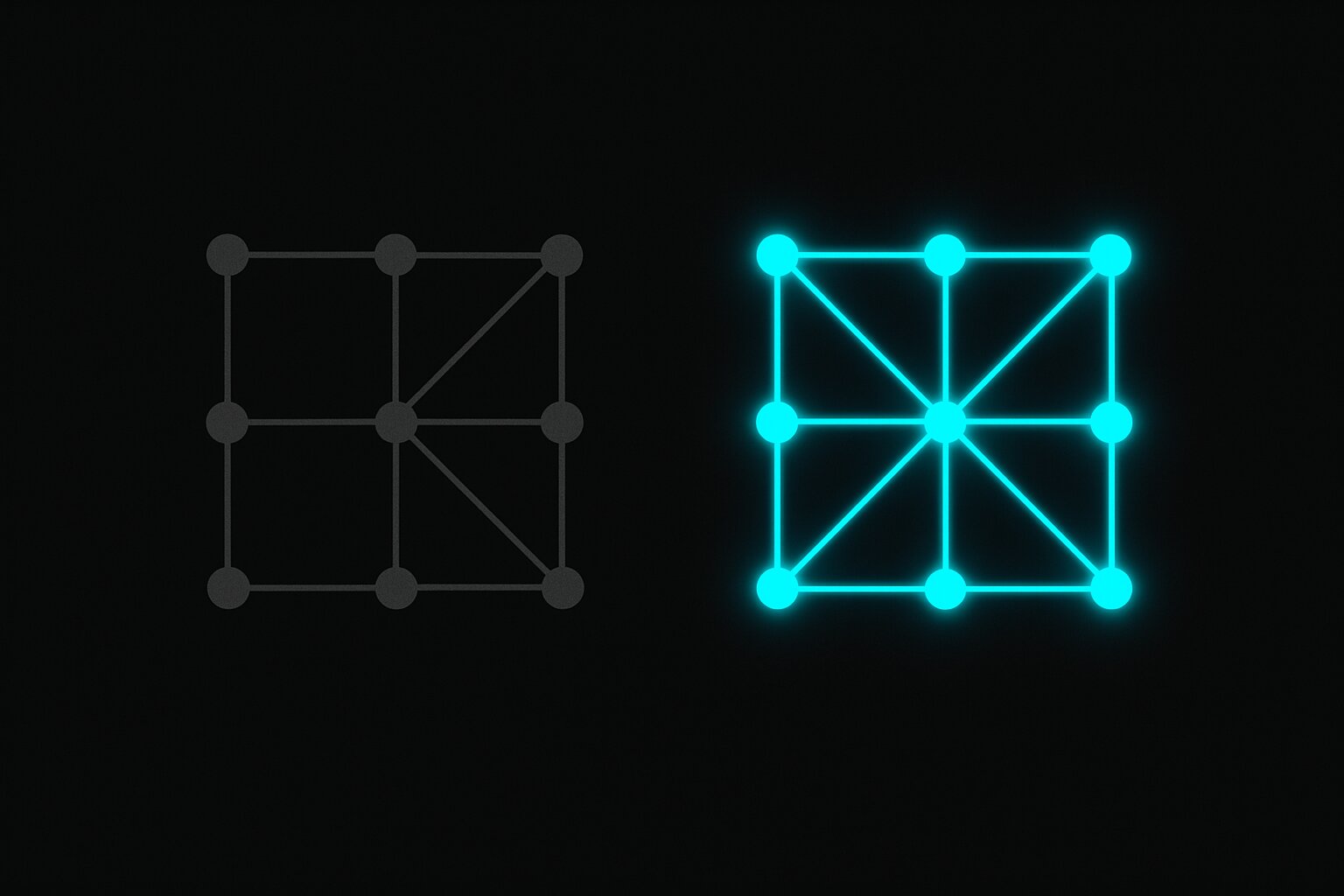
People who speak Sense don't see features or handoffs. They see architectures. They understand that a research agent plus an outreach agent plus a call analysis agent don't just save time in three places — they create a closed-loop system where each component makes every other component smarter. The research feeds the outreach. The outreach generates signal. The call analysis feeds pattern data back to the research. Every cycle compounds.
The value of this system is not the sum of the agents. It's closer to the product of their interactions. And that distinction — sum versus product — is the entire pricing gap, the entire ROI gap, and the entire reason most AI deployments disappoint.
This script has almost no native speakers. Management consultants sometimes approach it conceptually but lack the technical depth. Engineers understand the architecture but can't translate it into revenue impact. Economists grasp the theory but don't operate where it matters.
Sense is the Demotic script — the one that should sit between builders and operators, making each legible to the other. Right now, the stone is cracked, and the message is hard to decipher.
Putting it into Practice
The builder says: "We have an LLM-based scraping agent with 98% accuracy on company data extraction, plus an outreach agent that personalizes sequences, plus a call analysis agent that tags objection patterns."
The operator says: "My SDRs spend 60% of their time on LinkedIn research. Our outreach is generic. We have no idea why deals stall after the first meeting."
Same problem space. Completely different languages. Neither can see how the other's world connects to theirs.
The Sense translation: By connecting the scraper to the CRM and the outreach agent, you're not saving SDR time. You're building a self-correcting lead engine. The scraper feeds enriched accounts into outreach. Outreach sequences are personalized with real firmographic data. The call analysis agent identifies why deals stall and feeds that signal back to the scraper's targeting criteria. Every closed-lost deal makes the next hundred prospects more accurate.
Now, you have a system. And that system compounds in ways that individual tools never will.
Without the coordinating script, the vendor prices each tool at its task value. The operator buys one, maybe two, deploys them in isolation, and wonders why the ROI case doesn't hold up. The system that would have transformed their pipeline never gets built — not because the technology wasn't there, but because nobody could describe what it would become.
The Cost of the Cracked Stone
AI tool vendors are pricing at 10–20% of their potential value. They can describe what their agents do. They can't articulate the coordination economics of their suite. A $30K ACV that should be $200K — multiplied across hundreds of customers — represents billions in aggregate underpricing across the market.
Operators are capturing 20–30% of the potential value from their AI investments. Tools sit in silos. Nobody designed how they should work together. The gap between what these tools could deliver as a coordinated system and what they deliver as disconnected automations is where most of the promised ROI quietly disappears.
Both sides are spending money on the wrong things. Vendors invest in features that don't address coordination. Operators buy more tools that increase fragmentation. The translation layer that would direct resources to where they actually matter doesn't exist.
None of this is because anyone is incompetent. The three scripts evolved independently. The people who can read all of them haven't yet emerged as a recognized category.
Translation Time
When someone fluent in all three scripts enters the picture, the dynamics shift fast. This isn't always a third party — sometimes it's a RevOps lead, a product strategist, or a founder who picks up the missing script. The role matters more than who plays it.
For the vendor: they see the coordination architecture the agent suite enables — something the builder's own team can't see from inside the codebase. The sales narrative moves from "here's what each agent does" to "here's the operating system your agents create." Pricing restructures around system value, not task value.
For the operator: AI capabilities map directly onto the friction points constraining growth. Deployment gets sequenced to reduce fragmentation instead of adding to it. Results get measured at the system level, not the tool level.
For the market: a feedback loop forms that doesn't currently exist. What vendors build starts to connect to what operators need. The ecosystem evolves toward coordination value instead of fragmenting further.
The Question
The market is already feeling this gap. Conference panels debate "AI ROI" with no good answers because nobody in the room speaks all three languages. Vendor CEOs call it an expansion problem without realizing it's a translation problem.
The gap is too expensive to persist. Translators will emerge.
The question is what it costs you — in pricing, in pipeline, in positioning — to put off decoding all three scripts.
The market is starting to price the answer.